If you've searched for a women's prayer outfit online, you've probably run into three different terms: telekung, mukena and prayer dress.
At first they sound like three separate garments. Mostly they aren't. Telekung and mukena usually refer to the same Southeast Asian style of women's prayerwear, while prayer dress is the broader English term covering many different types of clothing worn for salah.
The main difference isn't religious function. It's language, culture and garment style.
The difference at a glance
Telekung is the term used in Malaysia, Singapore and Brunei, and it usually describes a loose prayer outfit traditionally made as a long head covering with a matching skirt. Mukena is the Indonesian name for a similar prayer outfit, commonly sold in one-piece and two-piece designs. Prayer dress is the term you'll hear in the UK and other English-speaking markets, and it covers any clothing designed to provide suitable coverage during prayer.
What is a telekung?
A telekung is a prayer garment traditionally worn by Muslim women in Malaysia, Singapore and Brunei.
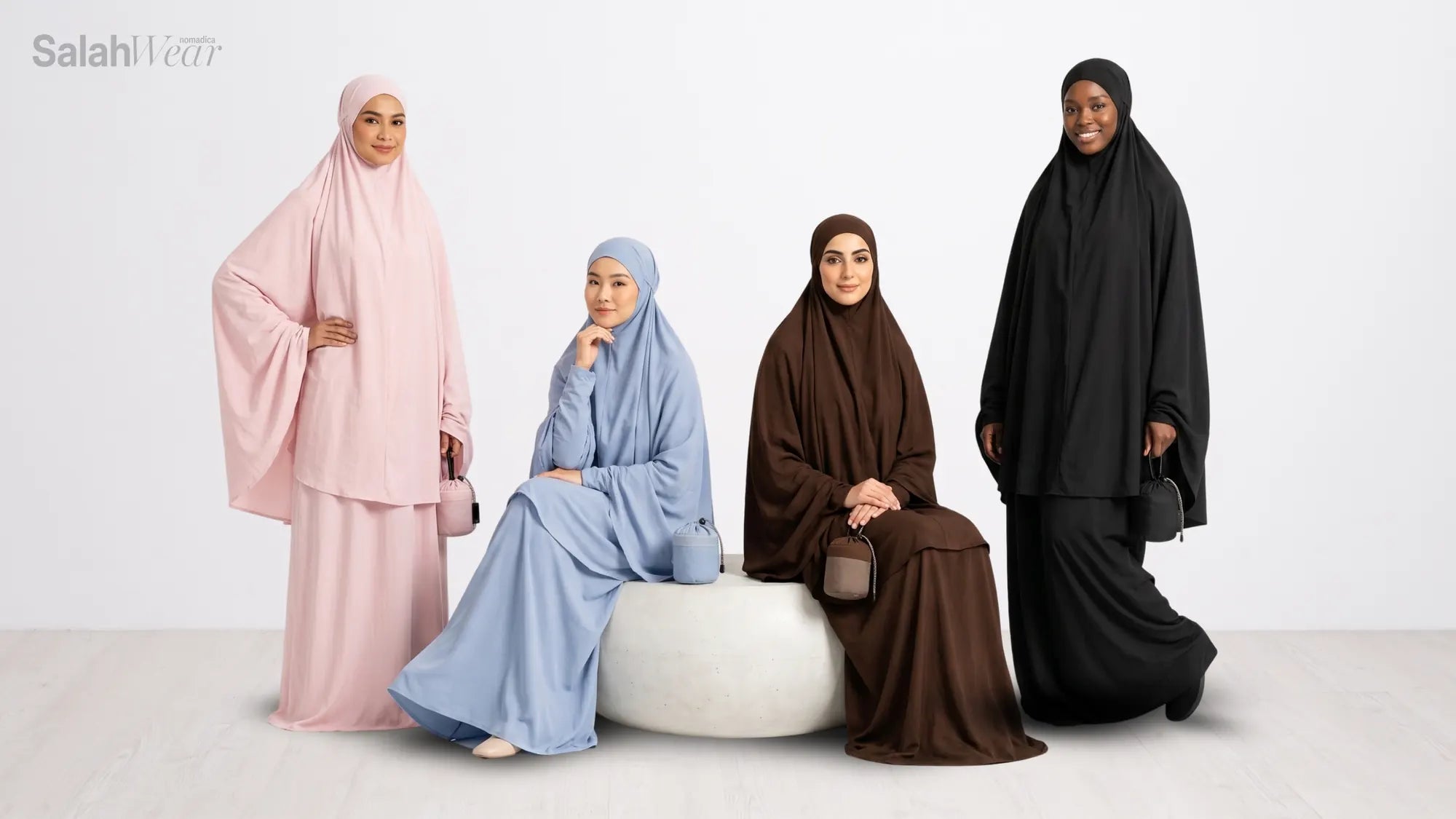
The classic telekung is normally a two-piece set: a long, flowing head covering that goes over the hair, neck, shoulders, arms and upper body, plus a full-length skirt that covers the lower body and feet. Only the face and hands stay visible.
The term is deeply familiar across the Malay-speaking world. Malaysia's official Malay-language reference defines telekung as a covering worn by women while praying and directly links it to the word mukenah. That's a good sign the two words describe essentially the same type of prayer garment rather than two different religious categories (Dewan Bahasa dan Pustaka).
Traditional telekung designs are often white and may include lace, embroidery or decorative edging. Modern versions come in different colours, prints and lightweight fabrics, including compact travel telekung designed to fit inside a handbag or suitcase.
What is a mukena?
A mukena is the Indonesian term for a women's prayer garment.
Like a telekung, a traditional mukena provides loose, full-body coverage for salah and leaves the face and hands uncovered. It's particularly associated with Muslim women in Indonesia, though the term is understood in neighbouring Southeast Asian countries too.
A mukena might be designed as a two-piece set with a long head covering and separate skirt, a one-piece garment that covers the body from head to floor, or a lightweight travel mukena that comes with a compact pouch.
The spelling mukena is most common in Indonesia. You'll also see mukenah or mukenah prayer dress used in Malaysia, Singapore and international online shops.
Are telekung and mukena the same?
In everyday use, yes, telekung and mukena are largely the same type of prayerwear.
The biggest difference is where each word gets used. Malaysians, Singaporeans and Bruneians are more likely to say telekung. Indonesians are more likely to say mukena. English-speaking shoppers might call either style a two-piece prayer dress or women's prayer set.
There can be regional differences in fabric, fit and decoration, but these are design variations, not fixed definitions. A Malaysian telekung might traditionally lean toward white fabric and lace trim, while an Indonesian mukena is more often offered in colourful prints. Modern designs overlap a lot, though. A plain, lightweight two-piece set could reasonably be called either a telekung or a mukena depending on who's shopping.
What is a prayer dress?
Prayer dress is the broader English term for a garment worn by Muslim women to get the coverage required for salah.
Unlike telekung and mukena, the phrase doesn't point to one specific regional design. A prayer dress could be a loose one-piece dress with an attached hijab, a long abaya supplied with a matching head covering, a khimar and skirt set, a two-piece telekung or mukena, or a lightweight prayer outfit made specifically for travel.
That's why shoppers looking for a prayer dress in the UK can find several very different silhouettes under the same product category. The phrase describes what the garment is for. Telekung and mukena tell you more about the cultural tradition and construction behind it.
Is a telekung or mukena required for prayer?
No. A woman doesn't have to wear a garment specifically called a telekung or mukena for her prayer to be valid.
The purpose of prayerwear is to provide the appropriate coverage for salah. Depending on what's already being worn, that coverage might come from an abaya, a long dress, a skirt and khimar, a jilbab, or another loose and sufficiently opaque outfit.
A telekung or mukena is popular because it creates that coverage quickly. It can go straight over everyday clothing without requiring a full outfit change.
For specific religious guidance on prayer coverage, it's best to consult a trusted scholar or local religious authority.
Why are telekung and mukena less familiar in the US and UK?
Muslim communities in the UK and US come from many different cultural backgrounds, so terms like prayer dress, prayer abaya, jilbab and khimar tend to be more familiar in British or American Muslim retail.
Telekung and mukena come out of Southeast Asian prayerwear traditions. Someone raised in Malaysia or Indonesia will likely recognise the design immediately, while a UK or US shopper encountering it for the first time might just see a practical two-piece prayer dress.
Even so, the telekung and mukena silhouette has some real advantages. It goes on directly over ordinary clothes. The separate skirt gives generous lower-body coverage. The long upper piece covers the hair, arms and torso together, so there's no need to coordinate a separate hijab. Lightweight versions can also be useful for work, travel and university.
If you're searching for a prayer dress in the UK or US, it's worth looking past the name and checking the garment's construction, fit and intended use.
One-piece or two-piece prayer dress: which is better?
Neither is automatically better. It depends on how and where you plan to use it.
A one-piece prayer dress makes sense if you want to put it on in a single step, prefer a simple, robe-like silhouette, don't want to fuss with a separate waistband, or mainly plan to use it at home.
A two-piece telekung or mukena makes more sense if you prefer separate upper and lower coverage, want more flexibility around the waist, already know the traditional Southeast Asian silhouette, or want something you can pack and carry in pieces.
When comparing products, check whether the face opening is adjustable, whether the fabric turns sheer under bright light, and whether the skirt stays put during movement.
How to choose a prayer dress in the UK or US
The climates and daily routines in Western countries like the UK or US make fabric and portability just as important as appearance.
Coverage. The outfit should stay loose and provide reliable coverage through standing, bowing and prostration. Check the sleeve length, skirt length, face opening and how opaque the material is.
Fabric weight. Heavy fabric can feel fine at home but becomes a hassle when travelling. A lightweight prayer dress is easier to carry, though it shouldn't be transparent or easily lifted by movement.
Fit. Many prayer dresses are sold in one size, but one size doesn't suit every height or body shape equally. Look for clear measurements or properly graded size options.
Secure face opening. A loose face opening can shift during prayer, while one that's too tight feels uncomfortable. An adjustable design fits more reliably.
Portability. If the prayer dress is getting carried to work, school, the mosque or on a trip, check its actual packed dimensions rather than trusting the word "travel."
Ease of care. A prayer outfit that's used often should be easy to wash and quick to dry, especially if it's being carried around regularly.

A Southeast Asian tradition, reimagined for modern life
Telekung and mukena aren't just alternative names for a generic dress. They're a recognisable Southeast Asian approach to prayerwear built around generous coverage, a flowing silhouette and an outfit kept specifically for salah.
Modern prayerwear can keep that familiar construction while improving portability, fit and performance. Our Nomadica Blend 01: Nusantara range draws from the traditional two-piece telekung and mukena silhouette and reworks it into a lightweight pouch prayer dress with an adjustable hood, secure coverage and a packed size of just 9 x 9 cm.
For women searching for a prayer dress in the UK or US, the Nusantara range brings the practicality of Southeast Asian prayerwear into a format that's easier to carry through everyday life.
Share:
How Long Can You Wear Wudhu Socks? 24 vs 72 Hours
Why Do Prayer Dresses Fly Up During Sujud?